
Rental Damage Disputes: What Your Photo Evidence Must Capture

Updated: 2 days ago
Strong rental car damage dispute evidence rests on two things: a condition record captured at handover and again at return under the same conditions, and an excess figure the customer saw before they paid. Photographs alone rarely settle an argument. Photographs paired with prior disclosure almost always do.
Most operators lose these disputes not because the damage is unclear, but because the record has a gap the customer can point at.
Why most damage disputes are lost before the car leaves
A dispute is an argument about two questions. Was the damage there before, and did the customer know what it would cost them?
The first question is evidential and depends on your handover record. The second is contractual and depends on what you disclosed at the point of booking. Operators tend to invest heavily in the first and neglect the second, which is why so many disputes end in a partial write-off even when the photographs are perfectly clear.
A customer who accepts that the scratch is theirs can still refuse to accept a S$1,500 excess they say nobody mentioned. At that point your photographs are irrelevant to the outcome.

For an owner, the cost sits in three places: the unrecovered repair, the staff hours spent arguing, and the review. The third is usually the most expensive and the only one that never appears in your accounts.
What the customer should have seen before they booked
Disclosure is the cheaper half of this problem and the half most operators skip.
In the Booknetics self-drive flow, the package screen carries a restrictions and terms block before the customer reaches payment. It shows the damage excess for that specific vehicle, an additional excess where one applies, and the driver criteria. In our demo fleet, a mid-range sedan carries a damage excess of S$1,500, and the driver criteria note explains that additional excess applies to young, senior or inexperienced drivers.
Putting those figures on the booking screen rather than in a terms document has a measurable effect on disputes. A customer cannot later claim they were not told, because the number sat beside the price they agreed to pay.
It will cost you a small number of bookings. That is the trade, and it is worth taking, because the hires you lose are disproportionately the ones that would have argued.
If you currently disclose excess only in the rental agreement signed at the counter, moving it forward to the booking screen is the single highest-return change in this article. You can see what the booking screen shows before payment on the self-drive flow.
What your departure photo set must capture
The purpose of the departure set is to make "it was already there" a question of fact rather than opinion. Standard vehicle handover practice, reflected in the widely used inspection templates, covers registration details, odometer reading, fuel or charge level, dashboard warning lights, exterior and interior condition, wheels and accessories, and signatures from both parties.

In practice, a set that holds up needs the following.
Photograph the odometer and the fuel or charge gauge with the ignition on, because a returned vehicle is usually disputed on distance or fuel before it is disputed on damage.
Photograph the dashboard with warning lights visible, since a light that appears during the hire is a different conversation from one that was already showing.
Photograph each exterior panel individually rather than shooting the car from four corners, because corner shots compress the middle of a panel and hide light scoring.
Photograph the wheels and tyres separately, as kerbed alloys are the most frequently disputed damage in city rentals and the hardest to see in a wide shot.
Photograph the glass, including the windscreen from inside, because a chip found at return is impossible to date without a departure image.
Photograph the interior seats, mats and boot, and record the accessories and key count.
Capture the images in daylight or under consistent lighting, since a scratch that is invisible under a covered carpark light will appear obvious in afternoon sun and the customer will say it is new.
The last point causes more failed disputes than any equipment problem. If your departure photographs are taken in a dim basement and your return photographs are taken outside, you have created the inconsistency yourself.
No commitment. We will walk through how your handover currently gets recorded and show you where the gap sits between what you capture and what you disclosed. Get a demo →
Why the return set has to mirror the departure set
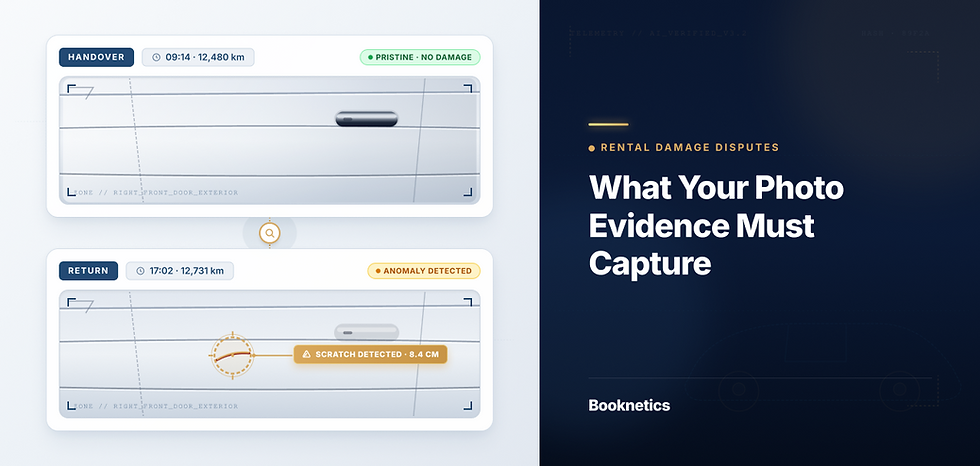
A photograph proves a condition at a moment. A pair of photographs proves a change. Only the pair is evidence.
That means the return set has to follow the same sequence, the same angles and the same lighting as the departure set. A departure set of twelve images and a return set of four does not let anyone compare like with like, and a customer's insurer will say so.
Fix the sequence and make it non-negotiable. Staff who photograph in a different order each time produce sets nobody can align, and the person reviewing the dispute six weeks later will not be the person who took them.
Timestamps matter as much as the images. A record that shows when each set was captured closes the argument that damage occurred in your yard after the vehicle came back.
Where the record should live
A photo record that sits in a staff member's phone gallery is not a business record. It is unavailable when that person is off, it disappears when they leave, and it cannot be attached to the booking it belongs to.
Booknetics keeps the list of upcoming bookings for preparing the vehicle, and supports uploading photographs for the vehicle checklist with an e-signature function, so the condition record and the customer's acknowledgement attach to the booking rather than living somewhere separate.

The e-signature is doing something specific here. A photograph shows the condition. A signature shows the customer agreed with what the photograph shows. Without the second, you have documentation rather than agreement, and a customer who never signed anything at handover can reasonably say they never inspected the car.
For operators running a broader operation, where the same vehicle also passes through a workshop and carries a repair and cost history, the condition record ideally feeds a wider system. That is the territory of car rental operators running a broader ERP, where damage, repair and depreciation sit on one vehicle record.
What to do when a dispute still happens
Some disputes survive good documentation, usually because the customer genuinely believes they did not cause the damage.
Lead with the pair of images rather than the excess figure. Showing the change first keeps the conversation about facts, and raising the money first makes it about the money.
Give the customer the same set you are relying on. Withholding images invites the accusation that you selected them, and a customer who has seen the full set is far more likely to settle.
Keep the finance trail separate from the argument. Invoices and payment documents are generated automatically, and cancellations run through defined refund policies, which means the commercial side does not have to wait for the dispute to conclude.
Accept that a small number of claims are not worth pursuing. If the repair sits well below the cost of the staff time and the reputational exposure, closing it quickly is the better commercial decision. Not every recommendation fits every operator, and a fleet of eight cars has a different threshold from a fleet of eighty.
A handover record checklist
Run this against your current process and fix the first item that fails.
Confirm the damage excess for each vehicle is visible to the customer before payment, not only in the signed agreement.
Fix a photograph sequence and require every member of staff to follow the same order.
Photograph panels, wheels, glass and interior separately rather than taking wide corner shots.
Standardise where handover photographs are taken, so departure and return lighting match.
Capture the odometer, fuel or charge level and dashboard on both sets.
Attach every set to the booking record, not to a personal device.
Obtain the customer's signature against the condition record at handover, so you hold agreement rather than only evidence.
Booknetics has confirmed over 200,000 bookings and more than S$48 million transacted across self-drive and chauffeur-driven operators, as of September 2026.
Disputes are cheaper to prevent than to win. We will look at your current handover record and show you what the customer would have seen before they paid. Get a demo →
Frequently asked questions
What photo evidence do I need for a rental car damage dispute?
You need a departure set and a return set taken in the same sequence, the same angles and comparable lighting, with timestamps. The set should cover each exterior panel individually, the wheels and tyres, the glass, the interior and boot, the odometer, the fuel or charge level, and the dashboard warning lights.
How many photos should I take at vehicle handover?
There is no fixed number, and consistency matters more than volume. A set that covers each panel separately rather than four corner shots typically runs to a dozen or more images, and the same count has to be repeated at return so the two sets can be compared directly.
What is a damage excess in car rental?
The damage excess is the amount the renter is liable for on damage before insurance covers the remainder. An additional excess may apply on top of it in certain cases, including hires by young, senior or inexperienced drivers, and disclosing both figures before payment is what makes them enforceable in practice.
Can a customer refuse to pay a damage excess?
They can dispute it, and the dispute usually turns on whether the figure was disclosed before they committed. An excess shown on the booking screen beside the price is far harder to contest than one buried in a terms document, which is why moving the disclosure earlier reduces disputes more than better photography does.
Do I need the customer to sign the handover record?
Yes, wherever possible. Photographs establish the condition of the vehicle, and a signature establishes that the customer agreed with that condition at the time. Without the signature you hold documentation rather than agreement, and a customer can argue they never inspected the vehicle before driving away.


Comments